Didnt Get Polio Again Today So Lit
Artwork past Ashlee Welz-Smith
Vaccination Resistance in Historical Perspective
Elena Conis
So-called anti-vaccinationists take gotten a lot of attention lately. This summer they were in the spotlight for protesting passage of California's new law eliminating personal and religious exemptions to required vaccines. They were blamed for the nationwide measles outbreak that originated in Disneyworld earlier this year; before that, they were blamed for the upsurge in pertussis, or whooping coughing, cases across the United States over the last few years. Follow the news and social-media chatter on such outbreaks of vaccine-preventable diseases, and yous'll see people who resist or delay vaccines for their children existence chosen "ignorant," "selfish," "stupid," and much worse.
You'll likewise see, repeated over and once again, an explanation equally to how this all began. Parents with vaccine worries, we're told, are those gullible enough to believe vaccine-skeptical celebrities such as Jenny McCarthy and a now-discredited British doctor, Andrew Wakefield, who published a since-retracted study on a link betwixt the MMR vaccine and autism back in 1998.
But this explanation is inaccurate. It too disregards history. Both the Wakefield study and McCarthy'south prominence every bit a vaccine skeptic were the products—not the cause—of today's parental vaccine worries, which date back to the 1960s (and before). (i) The vaccination skepticism of today is rooted in the social movements of the postwar era, which prompted a new generation of parents (and their children) to question environmental contaminants, drugs, doctors, and authority in general. Moreover, today's vaccination skepticism is an understandable response to late-twentieth-century trends in childrearing, a steadily growing mandatory vaccination schedule, and continually expanding rationales for vaccinating against disease.
But before I explain all that, information technology'south besides worth noting that vaccination resistance is zilch new. Popular doubts about vaccines and suspicions about the motives behind their use are equally sometime as vaccines themselves. The very offset vaccine, which protected against smallpox, was adult in England in the belatedly eighteenth century; information technology consisted of pus taken from a cowpox cicatrice, which was inserted into a small cut in the skin. As word of the new procedure spread, it was met with enthusiasm but also dread. While many patients and physicians were eager to fend off one of that era's most feared diseases, many others aghast at the prospect of contaminating their healthy bodies with disease affair from an animal.
When, in the early on nineteenth century, European nation states began making smallpox vaccination mandatory—for their armies, for the poor, or for the populace in general—societies of anti-vaccinationists formed to protestation what they saw as unequal treatment and undue infringement of private liberty. Antivaccinationism spread to the United states later that same century, largely via visitors and immigrants from Europe, and information technology has been with us ever since. (2)
Anti-vaccinationism was relatively muted, withal, when our modern era of vaccination got underway in the 1960s. In that decade, a series of new vaccines—to foreclose polio, measles, mumps, and rubella—were developed in rapid succession. Just a few years earlier, the American public had greeted the first polio vaccine, released in 1954, with wild enthusiasm. Parents so dreaded polio that they were quick to seek the vaccine for their children, and coercive policies never became necessary. (3) A few voices spoke out against the vaccine, but they got footling traction in a nation overwhelmingly drastic to forestall the disease.
As the 1960s began, health officials assumed parents would greet new vaccines with the same enthusiasm they had shown for the first polio vaccine. Merely they were incorrect. Families long accepted to living with measles, for instance, shrugged off the new vaccine against the disease. Middle-class parents tended to go it for their children if the family doctor recommended information technology, only not all doctors did. A chasm in infection rates opened up between lower-form families and middle- and upper-course families. And as health officials tried one promotional tactic after another without success, they ultimately returned to coercion, endorsing country policies that made the new vaccines a prerequisite for all children to enroll in school.
These trends signaled a new era of vaccination in the The states, one that was marked by four defining characteristics: the federal government assumed an increasingly prominent role in determining vaccination policy; vaccines increasingly targeted diseases that medical experts themselves considered "mild," transforming them into serious conditions in the process; vaccination campaigns aimed not just to reduce illness, but to eradicate it; and, finally, an increasing reliance on the vaccination of children, enforced through school vaccination laws, to ensure a guild free of preventable communicable diseases.
The mumps vaccine provides an illustrative example. Doctors and health officials considered the affliction a "mild" one when its vaccine was released in 1967. As a outcome, the medical community was separate over how the new vaccine should be used. Some believed all children should be vaccinated, while others believed none should be vaccinated, and still others felt that, since mumps was harmless in most children, only males who had escaped puberty without a case should exist vaccinated, since information technology was adult men who suffered the illness's most serious effects. The introduction of the new vaccine, however, inspired greater scrutiny of the illness, and every bit scientists at the federal Center for Illness Control ramped up investigations of mumps, they institute more than and more reasons to vaccinate. The more than closely they studied the disease, that is, the more serious information technology seemed. Eventually, a federal advisory committee, created in 1964 to streamline the nation's vaccination policies, recommended in 1977 that all children get vaccinated against mumps every bit a matter of convenience (since schoolhouse laws meant children were already getting vaccinated against measles, polio, and more than) and to ensure the disease would pose no threat to adults at gamble of the affliction.
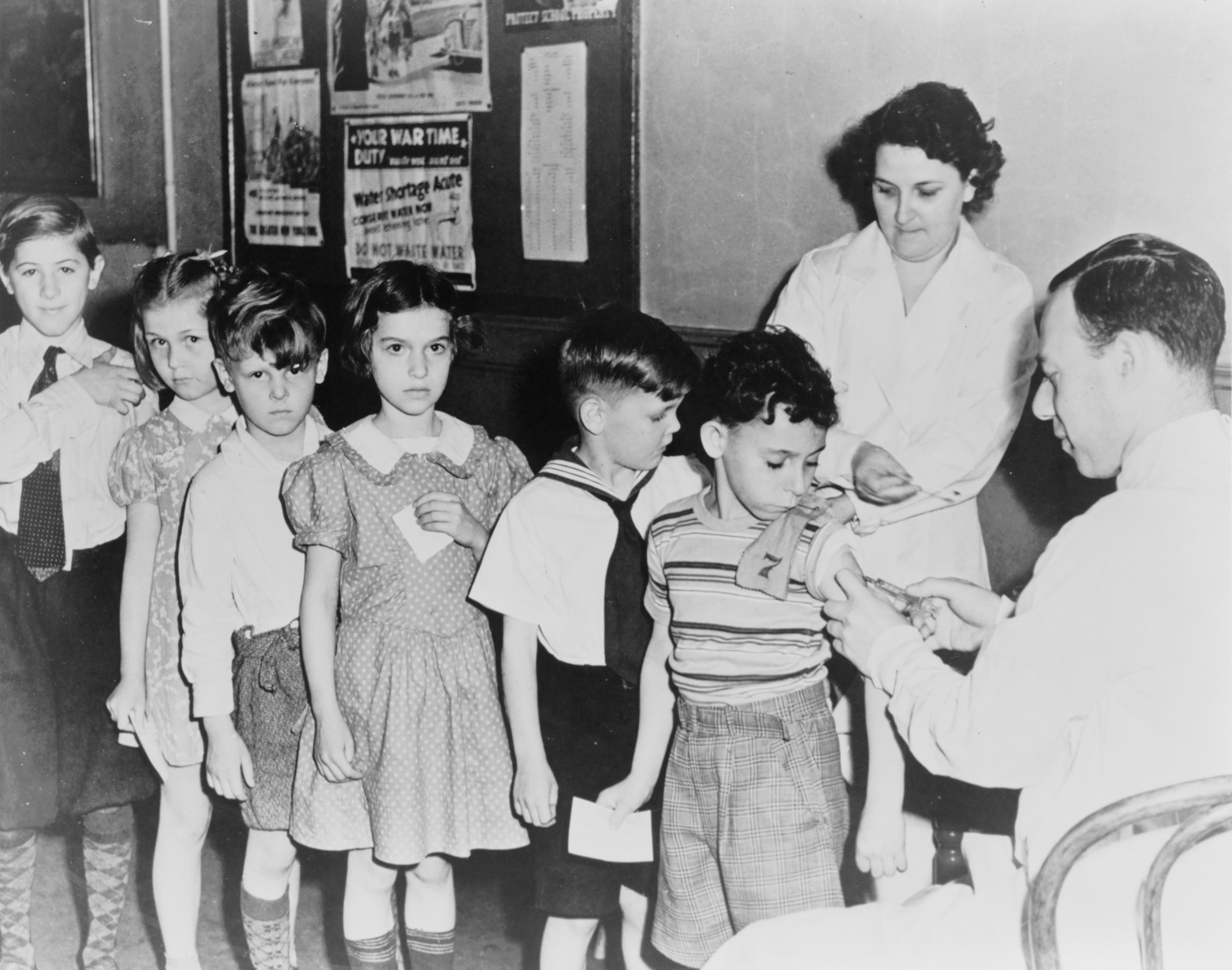
New York City children wait in line for immunization shots, c. 1944. Courtesy of Library of Congress.
The shift in the nation'southward vaccination agenda and arroyo coincided with an upsurge of social movements that encouraged Americans to question authority and traditional sources of expertise. Women pushed back confronting patriarchy. Environmentalists pushed back against industry. Patients pushed back against doctors. And equally the vaccine schedule and its enforcement expanded, a growing number of parents informed by the social movements of the day pushed back against required vaccines.
The rise of environmentalism and feminism, and particularly the ascension of the women'south wellness movement, had a marked effect on how parents began to view vaccines. In parenting magazines and advice columns of the 1970s, parents, peculiarly mothers, began to ask the aforementioned questions nigh vaccines that feminists had begun asking well-nigh drugs such equally the birth control pill in the 1960s: namely, are they necessary, and are they rubber? Some parents questioned whether the polio vaccine was necessary since no ane contracted the disease anymore. Others asked whether measles and mumps vaccines were safe, since they seemed to increase the chances that children might get the diseases later in life, when they would pose more serious risks. Still others began to seek out data on vaccine side effects and asked that doctors bear witness them vaccine package inserts earlier vaccinating—heeding, equally they did so, wellness feminists who urged women to become informed medical consumers in every medico-patient interaction.
The women's health move and patients' rights movement led parents to notice unexpected things about vaccines in the 1970s. Equally a California mother who culled the medical literature on vaccines put it in Mothering magazine, "What is known about vaccines is a whole other story from what is told." (iv) Vaccines carried known short-term risks that were rarely, if ever, disclosed to parents. They too contained ingredients that raised eyebrows and elicited serious concerns in an era marked past newfound worries near the long-term risks of chemic exposure. An Oregon parent and childbirth educator discovering that vaccines contained forms of aluminum, mercury, formaldehyde, and more asked why the harmful substances in cigarettes and saccharin had earned them alert labels, but the same wasn't true for vaccines. She was one of many vaccine skeptics who, in the era of new environmentalism, was increasingly concerned about the chemicals hidden in everyday life and their unknown long-term consequences.
In 1982, an NBC chapter in the Washington, D.C., area aired DPT: Vaccine Roulette, an hr-long investigative news report on the hazards of the pertussis component of the DPT (diphtheriapertussis- tetanus) vaccine. The broadcast collection home the idea of a paternalistic medical profession and revealed a critical loss of popular religion in authority. Mothers of vaccine-damaged children complained that their doctors hadn't listened to them, dissident doctors testified that the vaccine was no longer necessary, and government scientists suggested federal agencies had ignored and suppressed information implicating the vaccine in causing harm. At the cease of the broadcast, a meridian vaccine scientist appeared on screen and said that convulsions were not a contraindication against DPT vaccination. The camera then cut to a reporter, who read directly from the American Academy of Pediatrics' official warning against administering the shot to children who had previously suffered convulsions.
Vaccine Roulette inspired a group of parents to form an organization, Dissatisfied Parents Together, to abet for safer vaccines, greater regime oversight over vaccination, and federal compensation for the families of children harmed by vaccines. One of the system'south founders, Barbara Loe Fisher, went on to co-author a book, DPT: A Shot in the Dark (1985), which detailed the history of the pertussis vaccine and the struggles of parents whose children had been harmed by it. On several occasions, the book'due south authors invoked Rachel Carson'south Silent Leap, the 1962 bestseller that helped usher in the environmental movement with its warnings about pesticides. To them, Rachel Carson's tale about pesticides held a moral that applied to vaccines: "Simply as we take polluted our environment with manmade chemicals, we may well be polluting ourselves with a myriad of man-made vaccines in our quest to eradicate all disease and infection from the earth." (5)
The efforts of Dissatisfied Parents Together helped secure the passage of the National Childhood Vaccine Injury Human action of 1986, and in the years that followed, Fisher became a spokesperson for "vaccine condom." In the 1990s, the vaccine schedule for children connected to expand—just and so did dialogue about vaccines. A consumer representative was invited to sit on the federal advisory committee on vaccination. Journalists investigated the vaccine industry. Lawmakers asked scientists to closely evaluate vaccine ingredients and whole vaccines. And with each new vaccine that was canonical for market and required for children, parents continued to ask doctors questions they had started asking in the 1970s: is it necessary, is information technology prophylactic, and tin expert advice about it be trusted?
When, in 1998, the influential medical journal The Lancet published Wakefield's scientific newspaper on measles vaccination and autism, both Wakefield and the journal were responding to decades of public questioning about vaccines. In particular, they were responding to fears voiced by Fisher and many other vaccine critics who had questioned the connectedness between vaccines and intellectual disabilities, including autism, since the early 1980s.
Today, the link betwixt vaccines and autism has been then emphatically and repeatedly dismissed that it'south hard for many people to take seriously. Just in the early 2000s, the Plant of Medicine, a partitioning of the National Academies of Sciences, Engineering, and Medicine, took the purported link seriously enough to convene panels of experts to study the question. Twice the experts reviewed the evidence, and twice they concluded that, on rest, there was nearly nothing to worry nigh. But such reassurances coincided with the introduction of yet more vaccines, new rationales for vaccination (such equally vaccinating children to protect adults from disease, and to protect the economically productive time of working parents), and new transformations in the reputations of diseases sparked past the introduction of their vaccines. And with each new vaccine, parents had new opportunities to inquire questions about necessity and rubber first prompted by the social movements of decades before.
Every bit more and more than parents began to ask questions about vaccines, journalists and wellness experts began to look for places to pin blame. In plow, Vaccine Roulette, Barbara Loe Fisher, and Andrew Wakefield shouldered responsibility for the nation's growing vaccine jitters. Jenny McCarthy'due south plow came when she wrote in a bestselling book that she saw vaccines trigger her son's autism, and she afterward went on the Oprah Winfrey Show to talk almost information technology. But McCarthy was simply the latest figure to requite phonation to fears that were already simmering, thank you to the cultural backdrop in which the vaccine schedule was growing. That cultural backdrop took shape decades ago, when postwar social movements helped foster concern virtually chemic pollution; antipathy toward big industries; ambiguity toward modern medicine, doctors, and the health care organisation; and rejection of longstanding institutions of cultural say-so—all of which fueled modern skepticism about the everexpanding vaccine schedule and rationales behind new vaccine mandates.
That skepticism was on display when California's new vaccine law was being debated earlier this summertime. Just so was the age-sometime debate nearly the extent to which government can infringe on individual liberties in the name of public health. While proponents of the law said information technology was necessary to protect the lives of children against a long listing of infections, opponents deemed information technology oppressive because it violated the correct of children to education (since information technology bars unvaccinated children from school) and the right of parents to make health care decisions for their families.
The California vaccination contend echoes nineteenth- and early on-twentieth-century vaccination disputes. Back then, states responded to epidemics of vaccine-preventable disease with e'er-stricter laws and regulations requiring vaccination, and citizens who opposed vaccination pushed back with lawsuits and proposed legislation of their own. In time, other factors quieted the issue—in the face of war, or a new epidemic, or new cultural and economic preoccupations of the middle class, vaccination consensus often came easily. Merely, eventually, the issue always came back to the forefront. Americans' reasons for resisting specific vaccines have always reflected the norms and anxieties of a particular moment in time; our national dispute nigh how much power government should practice in enforcing vaccination, nonetheless, has been with us since the dawn of vaccination and shows no promise of permanent resolution.
ELENA CONIS is a historian of medicine and public health at Emory University. She is the author of Vaccine Nation: America's Changing Relationship with Immunization (2014), and she is currently working on a book on the history of the pesticide DDT.
NOTES
(1) For an extended discussion of Andrew Wakefield's and Jenny McCarthy's roles in gimmicky vaccination debates, see capacity 4 and v in Mark Largent, Vaccine: The Debate in Modern America (2012).
(2) Much scholarship has analyzed vaccination resistance in nineteenth-century and early-twentieth-century Europe and the United States. See for example Nadja Durbach, "'They Might likewise Brand Us': Working-Grade Resistance to Compulsory Vaccination in Victorian England," Social History of Medicine, thirteen (Apr 2000), 45–62; Robert D. Johnston, The Radical Centre Grade: Populist Democracy and the Question of Commercialism in Progressive Era Portland, Oregon (2003), 177–220; and Michael Willrich, Pox: An American History (2011), 246–84.
(3) On the history of the polio vaccine in the The states, see David M. Oshinsky, Polio: An American Story (2005); and Jane South. Smith, Patenting the Sunday: Polio and the Salk Vaccine (1990).
(4) Carol Horowitz, "Immunizations and Informed Consent," Mothering (Wintertime 1983), 37–41.
(five) Harris L. Coulter and Barbara Loe Fisher, DPT: A Shot in the Dark (1985), 407
Source: https://www.oah.org/tah/issues/2015/august/vaccination-resistance/

Postar um comentário for "Didnt Get Polio Again Today So Lit"