Isabella Stewart Gardner Museum Stolen Art in Storage Unit

In the early morn hours of March xviii, 1990, thirteen works of art were stolen from the Isabella Stewart Gardner Museum in Boston. Guards admitted two men posing as police officers responding to a disturbance call, and the thieves tied the guards upwards and looted the museum over the side by side hour. The instance is unsolved; no arrests have been made and no works have been recovered. The stolen works have been valued at hundreds of millions of dollars by the Federal Bureau of Investigation (FBI) and fine art dealers. The museum is offering a $10 one thousand thousand reward for information leading to the art's recovery, the largest compensation ever offered past a private institution.
The stolen works were originally procured by fine art collector Isabella Stewart Gardner (1840–1924) and intended for permanent display at the museum with the rest of her drove. Amid them was The Concert, one of only 34 known paintings by Johannes Vermeer and thought to be the most valuable unrecovered painting in the world. Likewise missing is The Tempest on the Sea of Galilee, Rembrandt's only seascape. Other paintings and sketches by Rembrandt, Edgar Degas, Édouard Manet, and Govert Flinck were stolen, along with a relatively valueless hawkeye finial and Chinese gu. Experts were puzzled by the choice of artwork, since more valuable works were left untouched. The drove and its layout are permanent, and so empty frames remain hanging both in homage to the missing works and as placeholders for their render.
The FBI believes that the robbery was planned past a criminal organization. The example lacks potent physical prove, and the FBI has largely depended on interrogations, undercover informants, and sting operations to collect information. They accept focused primarily on the Boston Mafia which was in the midst of an internal gang war during the period. I theory is that gangster Bobby Donati organized it to negotiate for his caporegime's release from prison house; Donati was murdered a year after the robbery. Other accounts propose that the paintings were stolen past a gang in Boston'south Dorchester neighborhood, though they deny involvement fifty-fifty later a sting operation put some of them in prison. All have denied any knowledge or accept given leads that were fruitless, despite beingness offered reward money, reduced prison sentences, and even liberty if they gave data leading to recovery of the art.
Background [edit]
The Isabella Stewart Gardner Museum was synthetic under the guidance of art collector Isabella Stewart Gardner (1840–1924) to house her personal art collection.[one] The museum opened to the public in 1903, and Gardner continued to expand the drove and arrange it until she died in 1924. She left the museum with a $3.6 meg endowment,[2] and her will stipulated that the arrangement of the artwork should not exist altered and no items were to be sold or bought into the collection.[1]
By the 1980s, the museum was running low on funds.[iii] This financial strain left the museum in poor condition; it lacked a climate control system and an insurance policy, and was in demand of basic building maintenance.[four] [5] [iii] Afterward the Federal Bureau of Investigation (FBI) uncovered a plot by Boston criminals to rob the museum in 1982, the museum allocated funds to improve security.[vi] Among these improvements were lx infrared motility detectors and a airtight-circuit television receiver organization consisting of four cameras placed around the building's perimeter.[7] [8] [6] There were no cameras installed within as the board of trustees thought installing such equipment in the historical building would be too expensive.[4] More than security guards were hired as well.[vi] Despite these security improvements, the only manner police could be summoned to the museum was with a button at the security desk. Other museums at the fourth dimension had fail-safe systems which required nighttime watchmen to brand hourly telephone calls to the police to point all was well.[8]
An contained security consultant reviewed the museum's operations in 1988 and determined they were on par with almost other museums, just recommended improvements.[six] The security director at the Museum of Fine Arts in Boston also suggested security upgrades to the museum.[9] Considering of the museum's financial strain and Isabella Stewart Gardner'southward wishes against any major renovations, the board of trustees did non approve these security enhancements.[vi] [10] [eleven] The board as well denied a asking from the security managing director for higher guard salaries in a bid to attract more qualified applicants for the job. The current guards were paid slightly above minimum wage.[12] The security flaws of the museum were an open up secret among the guards.[13]
Robbery [edit]

Prelude [edit]
The robbery occurred in the early hours of Sunday, March eighteen, 1990.[fourteen] The thieves were get-go witnessed effectually 12:xxxa.m. by several St. Patrick'due south Day revelers leaving a party nearly the museum.[xv] [14] The two men were bearded as police officers and parked in a hatchback on Palace Road, about a hundred anxiety from the side entrance.[16] [xiv] The witnesses believed them to exist policemen.[14]
The museum guards on duty that night were Rick Abath, age 23, and Randy Hestand, age 25; Abath was a regular night watchman and information technology was Hestand's beginning time on the night shift.[vii] The security policy maintained that one guard patrolled the galleries with a flashlight and walkie-talkie, while the other sat at the security desk.[seven] Abath went on patrol starting time. During his patrol, fire alarms sounded off in different rooms in the museum, but he could non locate any burn down or smoke.[viii] [17] Abath returned to the security room where the burn down alarm control panel indicated smoke in multiple rooms. He causeless some type of malfunction and shut down the panel.[8] [sixteen] He went dorsum on patrol and before he completed his rounds, made a quick stop at the side archway of the museum, briefly opening the side door and shutting it once again. He did non tell Hestand he was doing this or why.[16] Abath completed his tour and returned to the security desk around one:00a.chiliad., at which point Hestand began his rounds.[16]
Guards are subdued [edit]
At 1:20a.1000., the thieves collection up to the side archway, parked, and walked up to the side door.[15] [17] They rang the cablegram, which connected them to Abath through an intercom. They explained to Abath that they were constabulary investigating a disturbance and needed to be buzzed in.[15] Abath could run across them on the airtight-excursion goggle box wearing what appeared to be real police force uniforms.[15] [18] He was non aware of whatsoever disturbance, but theorized that as it was St. Patrick'due south Day, peradventure a reveler had climbed over the contend and someone had seen and reported information technology.[19] Abath let the men in at 1:24a.yard.[18] [20]
The thieves were permit into a locked foyer that separated the side door from the museum.[21] They approached Abath at his desk and asked if anyone else was in the museum and to bring them down; Abath radioed Hestand to return to the security desk.[21] [18] Abath noticed effectually this time that the mustache on the taller human being appeared fake.[21] The shorter man told Abath that he looked familiar, that they may have a warrant for his arrest, and to come out from behind the desk and provide identification.[21] Abath complied, stepping away from the desk where the only panic button to alarm police was.[21] [xviii] The shorter man forced Abath against a wall, spread his legs and handcuffed him. Abath noticed that he was non frisked.[22] Hestand walked into the room effectually this time, and the taller thief turned him around and handcuffed him.[22] Once both guards were handcuffed, the thieves revealed their true intentions to rob the museum and asked the guards to not give them any issues.[22]
The thieves wrapped duct record around the heads and optics of the guards. Without asking for directions, they led the guards into the basement where they were handcuffed to a steam pipe and workbench.[22] [23] The thieves examined the wallets of the guards and explained that they knew where they live, to not tell authorities anything and they would get a reward in nearly a twelvemonth.[22] [23] [24] It took the thieves less than xv minutes to subdue the guards; it was at present about i:35a.thousand.[25]
Stealing the works [edit]

The thieves' movements through the museum were recorded on infrared movement detectors.[26] Steps in the commencement room they entered, the Dutch Room on the second flooring, were not recorded until 1:48a.m.[25] This was 13 minutes after they finished subduing the guards, maybe waiting to make sure no police force were alerted.[25]
As the thieves approached the paintings in the Dutch Room, a device began beeping that would ordinarily trip when a patron was also close to a painting. The thieves smashed information technology.[27] [23] They took The Storm on the Bounding main of Galilee and A Lady and Gentleman in Black and threw them on the marble floor which shattered their glass frames. Using a blade, they cut the canvases out of their stretchers.[27] [28] [29] They also removed a large Rembrandt self-portrait oil painting from the wall simply left it leaning against a cabinet.[thirty] [29] Investigators believe they may have considered information technology likewise large to ship, potentially because information technology was painted on wood, not more than durable sheet like the others.[31] [thirty] Instead, the thieves took a small postage stamp-sized self-portrait carving past Rembrandt on display beneath the larger portrait.[32] [29] On the right side of the room, they removed Mural with Obelisk and The Concert from their frames.[33] The final piece taken from the room was an ancient Chinese gu.[34]
At i:51a.m., while one thief continued working in the Dutch Room, the other entered a narrow hallway dubbed the Short Gallery on the other terminate of the 2d floor. The other thief joined before long.[29] [34] In this room, they began removing screws for a frame displaying a Napoleonic flag, likely an endeavor to steal the flag. They appeared to accept given up partway through as not all the screws were removed, and ultimately only took the exposed eagle finial atop the flagpole.[34] [35] They too took five Degas sketches from the room.[34] [35] The last work stolen was Chez Tortoni from the Blue Room on the first floor.[26] [35] The museum'due south motion detectors did not detect any motion within the Blue Room during the thieves' time in the building.[26] The only footsteps detected in the room that night were Abath's during the ii times he passed through the gallery on his patrol before.[26]
Equally they prepared to leave, the thieves checked on the guards one last time and asked if they were comfortable.[36] They and then moved to the security director'southward role where they took the video cassettes that recorded their entrance on the airtight-circuit cameras, and the data impress-outs from the motion detecting equipment. The movement information was withal captured on a hard drive, which remained untouched. The frame for Chez Tortoni was left at the security director's desk-bound.[36] The thieves so moved to take the artwork out of the museum; the side entrance doors were opened one time at 2:40a.m. and over again for the final time at 2:45a.m.[37] [36] The robbery lasted 81 minutes.[36]
The adjacent shift of guards arrived subsequently in the morning and realized something was awry when they could non institute contact with anyone within to be let in. They chosen in a security managing director who, upon entering the edifice with his keys, establish nobody at the watch desk and called constabulary.[37] [38] The police force searched the building until they constitute the guards still tied in the basement.[39] [xl]
Stolen artwork [edit]
-
-
-

-

-

-

Self-Portrait – Rembrandt
-

La Sortie de Pesage – Degas
-

Cortege aux Environs de Florence – Degas
-

Program for an Artistic Soirée 1 – Degas
-

Program for an Artistic Soirée ii – Degas
-

Three Mounted Jockeys – Degas
-

An ancient Chinese gu
-
Xiii works were stolen. In 1990, the FBI estimated the value of the haul at $200 million[41] and raised this estimate to $500 million past 2000.[41] In the late 2000s, some art dealers suggested the haul could exist worth $600 one thousand thousand.[42] It was considered the highest-value museum robbery until it was surpassed by the Dresden Greenish Vault burglary in 2019.[43]
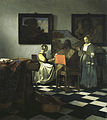
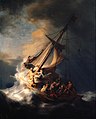
The virtually valuable works were taken from the Dutch Room.[44] [45] Among these was The Concert by Dutch painter Vermeer (1632–75), one of only 34[a] paintings attributed to him.[46] The painting accounts for one-half of the haul'due south value,[42] [47] estimated at $250 million in 2015.[32] Experts believe it may exist the nigh valuable stolen object in the globe.[47] [48] In the same room, the thieves targeted works by Dutch painter Rembrandt (1606–69).[44] These included The Storm on the Sea of Galilee, his only seascape and the most valuable of his works stolen that night.[49] [25] Estimates accept placed its value at about $140 million since the robbery.[41] The other Rembrandt works taken were A Lady and Admirer in Blackness and a minor postage stamp stamp-sized cocky-portrait etching.[32] [41] The latter was previously stolen and returned in 1970.[32] The thieves may take taken Landscape with Obelisk believing it was a Rembrandt; it was long attributed to him until it was quietly credited to his pupil Govert Flinck (1615–sixty) a few years before the heist.[32] The last item taken from the Dutch Room was a bronze gu about 10 inches (25 cm) alpine. Traditionally used for serving wine in aboriginal China, the beaker was i of the oldest works in the museum, dating to the Shang Dynasty in the 12th century BC.[50] [xx] Its estimated value is simply several 1000 dollars.[34]
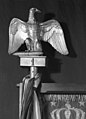
In the Short Gallery, five sketches by French creative person Edgar Degas (1834–1917) were stolen.[51] They were each done on paper less than a square human foot in size and made with pencils, inks, washes, and charcoal.[31] They are of relatively little value compared with the other stolen works,[31] worth under $100,000 combined.[34] As well taken was a 10-inch-tall (25 cm) French Imperial Eagle finial from the corner of a framed flag for Napoleon's Imperial Guard. There is a $100,000 reward for information leading to the return of the finial alone.[52] It perchance appeared like gilded to the thieves.[46] Chez Tortoni by French painter Édouard Manet (1832–1883) was taken from the Bluish Room; information technology was the only item taken from the beginning floor.[53]
The eclectic mix of items has puzzled experts.[34] [54] While some of the paintings were valuable, the thieves passed other valuable works by Raphael, Botticelli, and Michelangelo and left them undisturbed, opting to take relatively valueless items similar the gu and finial.[54] [29] [34] [35] The thieves never entered the tertiary flooring where Titian'south The Rape of Europa hung, one of the nearly valuable paintings in the city.[26] [55] The selection of works and the brutish means the thieves handled the artwork has led investigators to believe the thieves were non experts commissioned to steal particular works.[56] [57]
As Gardner's will decreed nothing in her collection should be moved, the empty frames for the stolen paintings remain hanging in their respective locations in the museum as placeholders for their potential return.[58] Because of the museum's low funds and lack of an insurance policy, the director solicited help from Sotheby's and Christie's sale houses to mail service a reward of $ane meg within iii days.[59] This was increased to $5 million in 1997.[60] In 2017, information technology was doubled to $x 1000000 with an expiration date ready for the stop of the twelvemonth.[61] [62] [63] This reward was extended post-obit an outpouring of tips from the public.[64] It is the largest compensation ever offered past a private institution.[b] [66] The reward is for "information that leads directly to the recovery of all of [their] items in skillful status".[67] Federal prosecutors have stated that anyone who willingly returns the items will not exist prosecuted. The statute of limitations expired in 1995 also, so the thieves and anyone who participated in the theft cannot be prosecuted.[68]
Early leads and people of interest [edit]
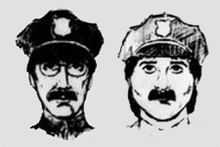
Police sketches of the thieves
The Federal Bureau of Investigation (FBI) took immediate command of the case on the grounds that the artwork could probable cantankerous state lines.[69] [70] Investigators have chosen the case unique for its lack of stiff concrete prove.[71] The thieves did not go out behind footprints or hair, and it is inconclusive if the fingerprints left at the scene were from the thieves or museum employees.[71] [72] The FBI has washed some DNA assay in the years post-obit as advancements in the field grew. Some of the evidence has been lost amongst their files.[73] The guards and witnesses in the street described i thief every bit about 5 anxiety nine inches (1.75 grand) to 5 feet 10 inches (ane.78 one thousand) in his late 30s with a medium build, and the other as 6 feet 0 inches (one.83 thousand) to 6 feet 1 inch (ane.85 m) in his early 30s with a heavier build.[13] [74]
Rick Abath [edit]
Security guard Rick Abath was investigated early considering of his suspicious behavior on the night of the theft.[26] [24] When on his patrol, Abath briefly opened and shut a side door,[16] a move which some believe could have been a signal to the thieves parked exterior.[75] Abath told authorities that he did this routinely to ensure the door was locked.[76] Ane of Abath's colleagues told journalists that if Abath had opened the door routinely every bit he maintains, supervisors would have seen information technology on computer printouts and put a stop to it.[76] More than suspicion has been fatigued from the museum's motion detectors, which did not detect any movement in the Blue Room (which housed Chez Tortoni) during the 81 minutes the thieves were in the museum. The simply footsteps in the room that night were Abath's during his security patrol.[26] A security consultant reviewed the move detector equipment several weeks afterwards the theft, and adamant they were operating correctly.[26] Abath maintains his innocence,[77] and the FBI amanuensis overseeing the case in its early years determined the guards were as well incompetent and foolish to have pulled off the crime.[24]
In 2015, the FBI released a security video from the museum on the night before the theft, showing Abath buzzing in an unidentified human into the museum to converse at the security desk-bound. Abath told investigators he could non recall the incident or recognize the homo, and so the FBI requested the public's assistance. Several former museum guards came forrad and said the stranger was Abath'southward boss, the museum'southward deputy security chief.[78]
Whitey Bulger [edit]
Whitey Bulger was 1 of the most powerful crime bosses in Boston during the era, heading the Winter Colina Gang.[79] He claimed he did non organize the heist, and in fact sent his agents out in an attempt to determine who did because the robbery was committed on his "turf" and he wanted to be paid tribute.[eighty]
FBI agent Thomas McShane investigated Bulger for his involvement.[79] He determined that Bulger'southward potent ties with the Boston Constabulary could explain how the thieves caused legitimate police force uniforms, or maybe that real police force were arranged to practice the heist.[79] Bulger as well had relations with the Irish Republican Army (IRA).[79] McShane identified the bogus tripping of the fire alarm alee of the heist a "calling card" of the IRA and the rival Ulster Volunteer Strength (UVF).[79] Both organizations had agents in Boston at the fourth dimension, and both had demonstrated capability in the past of pulling off art heists.[79] McShane'due south investigation of Bulger and the IRA did not produce any evidence to tie them to the theft.[81] According to Charley Colina, a retired fine art and antiquities investigator for Scotland Yard, Bulger gave the Gardner works to the IRA and they are most likely in Ireland.[82]
1994 letter to the museum [edit]
In 1994, museum manager Anne Hawley received an anonymous letter from someone who claimed to be attempting to negotiate a render of the artwork.[83] The author explained that they were a third-party negotiator and did non know the identity of the thieves.[84] They explained that the artwork was stolen to reduce a prison sentence, merely as the opportunity had passed, there was no longer a motive to keep the artwork and they wanted to negotiate a return.[85] The author explained that the artwork was beingness held in a "non-common law land" under climate-controlled weather condition.[86] [84] They wanted amnesty for themselves and all others involved, and $2.6 million for return of the artwork, which would be sent to an offshore bank business relationship at the aforementioned time the fine art was handed over.[84] If the museum was interested in negotiating, they should print a coded message in The Boston World.[87] To establish credence, the author conveyed information only known past the museum and FBI at the time.[83]
Hawley felt this was a strong atomic number 82.[88] She contacted the FBI, who then contacted the Globe and the coded bulletin was printed in the May 1, 1994, edition of The Boston Earth.[89] Hawley received a second alphabetic character a few days later on in which the writer acknowledged the museum was interested in negotiating, but had become fearful of what they perceived was a massive investigation by federal and country government to determine their identity.[90] The author explained that they needed time to evaluate their options, but Hawley never heard from the writer once again.[91]
Brian McDevitt [edit]
Brian McDevitt was a conman from Boston who tried to rob The Hyde Collection in Glens Falls, New York in 1981.[92] He dressed up as a FedEx driver, carried handcuffs and duct tape, and planned to steal a Rembrandt.[92] He was also a known flag addict, and fit the description of the larger robber except for his thinning red hair.[93] These parallels to the Gardner example fascinated the FBI so they interviewed him in late 1990.[92] McDevitt denied any interest and refused to take a polygraph test.[92] [93] The FBI ran his fingerprints which did non match whatsoever of those at the crime scene.[92] McDevitt afterward moved to California and bamboozled his fashion into idiot box and flick writing.[92] [93] He died in 2004.[92]
Investigation of the Boston Mafia [edit]
Merlino gang [edit]
The FBI announced significant progress in their investigation in March 2013. They reported "with a loftier degree of confidence" that they identified the thieves, which they believed were members of a criminal organization based in the mid-Atlantic and New England. They also felt "with that same confidence" that the artwork was transported to Connecticut and Philadelphia in the years following the theft, with an attempted sale in Philadelphia in 2002. Their cognition of what happened afterwards that is express, and they requested the public's help to locate and return the artwork.[94] [67] In 2015, the FBI stated both thieves were deceased.[95] Though the FBI did not publicly place any individuals, sources familiar with the investigation said they were associated with a gang from Dorchester.[94] The gang was loyal to Boston Mafia boss Frank Salemme and ran their operations out of an automobile repair shop run by criminal Carmello Merlino.[96] [97] [98]
Merlino'due south assembly may have gained knowledge of the museum's weaknesses after gangster Louis Royce cased information technology as early as 1981.[99] [100] He devised plans with an associate to light up smoke bombs and rush the galleries amidst the confusion.[101] [102] In 1982, when undercover FBI agents were investigating Royce and his associates for an unrelated art theft, they learned of their interest in robbing the Gardner Museum and warned the museum of the gang's programme.[103] [104] Royce was in prison at the time of the robbery.[105] Royce shared his plan with others and believes associate Stephen Rossetti may have ordered the robbery or shared it with someone else.[106] [107]
Robert Guarente and Robert Gentile [edit]
Among those associated with the Merlino gang were Robert Guarente and Manchester, Connecticut, gangster Robert Gentile.[108] [109] [110] Guarente died from cancer in 2004,[111] but his widow Elene told the FBI in 2010 that her husband had previously owned some of the paintings.[110] She claimed that when her husband got sick with cancer in the early on 2000s, he gave the paintings to Gentile for safekeeping.[108] [112] Gentile denied the accusations,[112] claiming he was never given them and knew nothing of their whereabouts.[113] Federal regime indicted Gentile on drug charges in 2012, likely in an endeavor to pressure Gentile for information about the Gardner works.[114] He submitted to a polygraph test which indicated he was lying when he denied any knowledge of the theft or location of the artwork.[115] Gentile maintained he was telling the truth and demanded a retest. During the retest he said Elene had once shown him the missing Rembrandt cocky-portrait, to which the polygraph machine indicated he was telling the truth.[116] Gentile'southward lawyer felt that the veracity of Gentile's claims were existence affected by the large presence of federal agents, and requested a smaller meeting in hopes that information technology would go Gentile to speak honestly.[116] In the more than intimate meeting, Gentile maintained that he did not have any information.[117]
A few days afterward, the FBI stormed Gentile's house in Manchester with a search warrant.[118] The FBI institute a secret ditch below a false floor in the lawn shed, but found it empty.[119] Gentile'southward son explained that the ditch flooded a few years prior and his father was upset about any was stored in that location.[120] In the basement, they found a copy of the Boston Herald from March 1990 reporting the theft along with a piece of newspaper indicating what each piece might sell for on the black market.[118] Across this, no conclusive prove was found to indicate he ever had the paintings.[ citation needed ] Gentile went to prison house for 30 months on drug charges. If he knew information well-nigh the theft, at no point did he opt to share it, which would have reduced his sentence or freed him from prison house.[ citation needed ] Afterwards getting out of prison, he spoke with investigative reporter Stephen Kurkjian, claiming he was framed by the FBI. He explained how the imprisonment was detrimental to his finances and personal life.[121] He also explained that the list constitute in his basement was written up past a criminal trying to broker return of the works from Guarente and was talking to Gentile as an intermediary.[122] When asked almost what could take been in the ditch, Gentile could not recall only believed it could take been small motors.[120]
David Turner [edit]
David Turner was another associate of Merlino.[123] [124] [98] The FBI began investigating him in 1992 when a source told them Turner had access to the paintings.[125] Merlino was arrested that same yr for cocaine trafficking and told authorities that he could return the paintings for a reduced prison sentence.[126] He asked Turner to track down the paintings; Turner failed to though he heard they were in a church building in South Boston.[127] [128] Another associate arrested in the drug sting told regime about Turner's interest in several break-ins, merely never mentioned the Gardner heist.[128] Based on conversations with Merlino afterward his release from prison in the mid 1990s, authorities gathered that Merlino never had direct admission to the paintings but maybe could broker for their return.[129]
Despite his claims of innocence, the FBI believes he may accept been 1 of the thieves.[130] [131] Evidence indicates that he went to Florida to pick up a cocaine guild only days before the heist,[132] and credit card records propose he remained there through the night of the robbery,[133] [134] merely some investigators believe this may take been Turner's attempt at creating an alibi.[ citation needed ] The FBI thinks the other thief was his friend and Merlino associate George Reissfelder.[131] [135] He died in July 1991.[136] No clues were found in his flat or the homes of friends and relatives,[131] [136] but his siblings recollect a painting similar to Chez Tortoni in his bedchamber.[131] Investigators believe he looks like to the slimmer man in the police sketches.[137]
In 1999, the FBI arrested Turner, Merlino, Rossetti, and others in a sting operation the twenty-four hour period they planned to rob a Loomis Fargo vault.[138] [98] When the FBI brought Turner in for questioning, they told him they had information that he participated in the Gardner robbery, and that if he returned the paintings, they would let him go.[139] He told the authorities he did non know who stole the paintings nor where they could be hidden.[140] In his 2001 trial, he claimed entrapment, that the FBI permit the Loomis Fargo plot proceed and then they could force per unit area him for information most the Gardner paintings.[140] The jury plant him guilty and he was sent to prison.[139] Turner knew Gentile through Guarente, and in 2010, wrote a letter to Gentile request if he could telephone call Turner's former girlfriend to assist in recovering the Gardner paintings.[141] In cooperation with the FBI, Gentile spoke with Turner's girlfriend, and she told him that Turner wanted him to speak with ii of his ex-convict friends in Boston.[142] The FBI wanted Gentile to meet the men and ship an FBI hush-hush agent with him, only Gentile did not want to cooperate further.[142] Turner was freed in Nov 2019, one calendar month after Stephen Rossetti.[143] Merlino died in prison house in 2005.[143]
Bobby Donati [edit]

Criminal Bobby Donati was murdered in 1991 in the midst of a gang war inside the Patriarca crime family.[144] [145] His involvement in the Gardner theft was suspected afterward notorious New England fine art thief Myles J. Connor Jr. spoke with regime.[146] [147] Connor was in jail at the time of the heist,[148] but he believed Donati and criminal David Houghton were the masterminds.[148] Connor had worked with Donati in by art heists,[149] and claimed the two cased the Gardner Museum[148] [150] where Donati took interest in the finial.[148] Connor also claimed that Houghton visited him in jail after the heist and said that he and Donati organized it and were going to utilise the paintings to get Connor out of jail.[149] If this is truthful, they likely borrowed the idea from Connor equally he returned art to reduce sentences in the past.[150] Even though Donati's and Houghton's appearances did not fit the witness descriptions, Connor suggested they probably hired lower-level gangsters to carry out the robbery.[148] Like Donati, Houghton likewise died within ii years of the robbery, though from an illness rather than murder.[148] Connor told investigators he could assist in returning the Gardner works in exchange for the museum'southward posted reward and his freedom.[148] When investigators did not requite into Connor'due south demands considering of lack of evidence, he suggested they speak with criminal and antiques dealer William P. Youngworth.[148]
Acting on Connor's lead, the FBI opened a case on Youngworth and conducted raids on his home and antique store properties in the 1990s.[151] [146] [152] The raids defenseless the attention of journalist Tom Mashberg, who began talking with Youngworth in 1997 about the theft.[151] [146] I night in August 1997, Youngworth chosen Mashberg and told him he had proof he could return the Gardner paintings under the right conditions.[153] That night, Youngworth picked up Mashberg from the Boston Herald offices and drove him to a warehouse in Red Hook, Brooklyn.[153] [154] Youngworth led him inside to a storage unit with several large cylinder tubes. He removed one painting from its tube, unfurled information technology, and showed it to Mashberg under flashlight. It appeared to Mashberg to exist The Tempest on the Body of water of Galilee. He noticed bang-up along the sail and the edges were cut in a fashion consistent with the museum'due south reports,[155] too equally Rembrandt's signature on the ship'due south rudder.[156] Mashberg wrote nearly his experience in the Boston Herald, leaving out details to hide Youngworth'due south identity and the painting's location.[157] He reported that his "informant" (presumably Youngworth) told him the robbery was pulled off by five men and identified 2: Donati was ane of the robbers, and Houghton was responsible with moving the fine art to a safety house.[158] The FBI discovered the location of the warehouse several months later on and raided information technology, finding nothing.[159]
The veracity of Youngworth's claims and the authenticity of the painting shown to Mashberg is disputed.[160] Youngworth supplied paint chips to Mashberg, and federal authorities reported that they were indeed from Rembrandt'southward era, but did non lucifer oils used for The Storm on the Sea of Galilee.[160] The way Mashberg described the painting equally being "unfurled" has likewise been scrutinized, as the stolen painting was covered with a heavy varnish that would not curl easily.[160] Federal regime and the museum began working with Youngworth after Mashberg'due south story was published, but Youngworth made negotiations hard.[159] He would not work with government unless his demands could exist met, which included total immunity and Connor's release from jail.[159] [161] [162] The authorities were skeptical of Youngworth's veracity, and simply offered fractional immunity.[162] The United States attorney overseeing the case somewhen ceased talks with Youngworth unless he could provide more reliable prove that he had access to the Gardner works.[159] Youngworth once more provided a vial of paint chips, purportedly from The Storm on the Bounding main of Galilee, and 25 color photographs of the painting and A Lady and Gentleman in Black.[163] A joint statement from the museum and federal investigators announced that the chips were not from the stolen Rembrandts, though they did test every bit being from 17th century paintings and could potentially be from The Concert.[164]
In 2014, investigative reporter Stephen Kurkjian wrote to gangster Vincent Ferrara, Donati's superior during the gang state of war, inquiring if he had information nearly the Gardner theft.[165] [166] He received a remember from an associate of Ferrara who explained the FBI was incorrect in suspecting the Merlino gang's involvement and claimed that Donati organized the robbery.[165] The caller explained that Donati visited Ferrara in jail near three months before the theft, after the latter was charged for murder,[167] and told Ferrara that he was going to do something to get him out of jail.[168] Three months subsequently, Ferrara heard news about the Gardner theft,[168] after which Donati visited him again and confirmed to Ferrara that he was involved in the robbery.[169] He claimed to have buried the artwork and would commencement a negotiation for his release one time the investigation cooled downwards.[144] The negotiations never occurred because Donati was murdered.[144] Kurkjian believes Donati was motivated to free Ferrara from prison because Ferrara could protect him in the gang war.[166] A friend of Guarente also corroborated that Donati organized the robbery, and that Donati gave paintings to Guarente when he became concerned for his own safety.[170] Donati was close friends with Guarente.[171] The two were seen at a social club in Revere shortly before the robbery with a bag of police uniforms.[171]
In pop culture [edit]
Fictional accounts of the robbery and what occurred to the paintings were explored on boob tube shows Blindspot, The Blacklist, The Venture Bros., Shameless and The Simpsons,[172] [173] as well as the novels The Art Forger (2012) past B.A. Shapiro, Artful Deception (2012) past James J. McGovern,[174] [175] Charlesgate Confidential (2018) past Scott Von Doviak, The Hidden Things (2019) by Jamie Mason,[176] The Mob Zone (2020) past Joseph DeMatteo, A Discerning Eye (2020) by Ballad Orange and The Secrets of Alias Matthew Goldman (2021) by Susan Grundy.
In 2007 the TV series "Monk" (Season 5, Episode 11) Mr. Monk Makes a Friend, "The Concert" past Vermeer can exist seen hanging on the wall of art thief Hal Tucker's, (Andy Richter,) flat.[177]
In October 2020, BBC Iv released a documentary nigh searching for the art titled The Billion Dollar Fine art Hunt.[178] In April 2021, Netflix released an original four-part documentary serial nearly the theft, This Is a Robbery: The World's Biggest Art Heist.[179]
Notes [edit]
- ^ The number of paintings attributed to Vermeer is disputed.
- ^ The Gardner Museum's advantage has merely been exceeded by the Usa authorities'due south $25 million bounty for Osama bin Laden.[65]
References [edit]
- ^ a b "Isabella Stewart Gardner". www.gardnermuseum.org . Retrieved September 29, 2019.
- ^ Boser 2009, p. 86.
- ^ a b Boser 2009, p. 86-87.
- ^ a b Kurkjian 2015, p. 34.
- ^ Kurkjian 2015, p. 36.
- ^ a b c d due east Boser 2009, p. 85.
- ^ a b c Kurkjian 2015, p. 40.
- ^ a b c d Kurkjian 2015, p. 41.
- ^ Kurkjian 2015, p. 32.
- ^ Kurkjian 2015, p. 33.
- ^ Kurkjian 2015, p. 37.
- ^ Boser 2009, p. 84-85.
- ^ a b Kurkjian 2015, p. 46.
- ^ a b c d Boser 2009, p. 1.
- ^ a b c d Kurkjian 2015, p. 43.
- ^ a b c d east Kurkjian 2015, p. 42.
- ^ a b Boser 2009, p. 3.
- ^ a b c d Boser 2009, p. four.
- ^ Kurkjian 2015, p. 43-44.
- ^ a b McShane 2006, p. 250.
- ^ a b c d due east Kurkjian 2015, p. 44.
- ^ a b c d eastward Kurkjian 2015, p. 45.
- ^ a b c Boser 2009, p. 5.
- ^ a b c Boser 2009, p. 94.
- ^ a b c d Kurkjian 2015, p. 48.
- ^ a b c d e f thou h Kurkjian 2015, p. 53.
- ^ a b Kurkjian 2015, p. 49.
- ^ Boser 2009, p. 6.
- ^ a b c d e Boser 2009, p. vii.
- ^ a b Kurkjian 2015, p. 49-fifty.
- ^ a b c McShane 2006, p. 251.
- ^ a b c d eastward Kurkjian 2015, p. 50.
- ^ Kurkjian 2015, p. 50-51.
- ^ a b c d e f thousand h Kurkjian 2015, p. 51.
- ^ a b c d Boser 2009, p. 8.
- ^ a b c d Boser 2009, p. 9.
- ^ a b Kurkjian 2015, p. 57.
- ^ Boser 2009, p. 89.
- ^ Kurkjian 2015, p. 59.
- ^ Boser 2009, p. ninety.
- ^ a b c d Boser 2009, p. 68.
- ^ a b Boser 2009, p. 69.
- ^ Chocolate-brown, Kate (November 25, 2019). "Thieves Stole Upwards to a Billion Dollars Worth of Jewels From Dresden's Famed Treasure Museum". Artnet News.
- ^ a b Gardner Museum 2018, p. twenty.
- ^ Goldfarb 1995, p. 92.
- ^ a b "FBI – Have Yous Seen These?". Federal Agency of Investigation. Archived from the original on September fifteen, 2015. Retrieved September 8, 2015.
- ^ a b Gardner Museum 2018, p. 32.
- ^ Boser 2009, p. 37.
- ^ Gardner Museum 2018, p. xxx.
- ^ Gardner Museum 2018, p. 22.
- ^ Gardner Museum 2018, p. 14.
- ^ Gardner Museum 2018, p. 18.
- ^ Gardner Museum 2018, p. x.
- ^ a b Wittman 2010, p. 252.
- ^ McShane 2006, p. 251,254.
- ^ Boser 2009, p. 73-74.
- ^ Kurkjian, Stephen (March 2013). "Decades later on the Gardner heist, police focus on guard". Boston Globe. Archived from the original on September 28, 2015.
- ^ McShane 2006, p. 266.
- ^ Boser 2009, p. 92.
- ^ Boser 2009, p. 115.
- ^ Gardner Museum staff (May 2017). "Isabella Stewart Gardner Museum : Gardner Museum doubles advantage to $10 1000000 for render of stolen art". www.gardnermuseum.org . Retrieved May 26, 2017.
- ^ Bowley, Graham (May 23, 2017). "Gardner Museum Doubles Reward for Recovery of Stolen Masterpieces". The New York Times. ISSN 0362-4331. Archived from the original on May 24, 2017. Retrieved May 24, 2017.
- ^ Irish potato, Shelley (December 15, 2017). "$10m reward for stolen Gardner museum artwork set to elapse at end of 2017". The Boston Globe . Retrieved December 16, 2017.
- ^ "$10M Advantage Extended For Return Of Stolen Gardner Museum Art". CBS. January 11, 2018. Retrieved January 16, 2018.
- ^ Boser 2009, p. 59.
- ^ Boser 2009, p. 58.
- ^ a b Comcowich, Greg (March xviii, 2013). "FBI Provides New Information Regarding the 1990 Isabella Stewart Gardner Museum Art Heist: Information Sought from Those in Philadelphia and Connecticut Who May Have Knowledge of the Fine art's Location" (Press release). Federal Agency of Investigation, Boston Segmentation. Archived from the original on July x, 2017.
- ^ Kurkjian 2015, p. 176.
- ^ Kurkjian 2015, p. 60.
- ^ Kurkjian 2015, p. 93.
- ^ a b Boser 2009, p. 97.
- ^ McShane 2006, p. 257-258.
- ^ Irish potato, Shelley; Kurkjian, Stephen (June 12, 2017). "Evidence in Gardner Museum thefts that might bear DNA is missing". The Boston Globe. Archived from the original on December 28, 2017. Retrieved June 12, 2017.
- ^ McShane 2006, p. 257.
- ^ Kurkjian 2015, p. 55-56.
- ^ a b Kurkjian 2015, p. 56.
- ^ Kurkjian 2015, p. 54.
- ^ Kurkjian 2015, p. 56-57.
- ^ a b c d e f McShane 2006, p. 256.
- ^ Kurkjian 2015, p. 96.
- ^ McShane 2006, p. 259.
- ^ Suddath, Claire (June xxx, 2020). "The Example of the Empty Frames Remains Art World's Biggest Mystery". Bloomberg News . Retrieved July 2, 2020.
- ^ a b Kurkjian 2015, p. 79.
- ^ a b c Kurkjian 2015, p. 81.
- ^ Kurkjian 2015, p. 80.
- ^ Kurkjian 2015, p. 79-lxxx.
- ^ Kurkjian 2015, p. 81-82.
- ^ Kurkjian 2015, p. 82.
- ^ Kurkjian 2015, p. 82-83.
- ^ Kurkjian 2015, p. 82-84.
- ^ Kurkjian 2015, p. 84.
- ^ a b c d due east f thousand Boser 2009, p. 97-98.
- ^ a b c McShane 2006, p. 262.
- ^ a b Kurkjian 2015, p. 114-118.
- ^ "FBI says ii suspects who stole $500m in art from Boston museum are dead". The Guardian. August vii, 2015. Archived from the original on August 14, 2015. Retrieved August 12, 2015.
- ^ Kurkjian 2015, p. 190.
- ^ Kurkjian 2015, p. 180.
- ^ a b c Boser 2009, p. 99.
- ^ Kurkjian 2015, p. 191.
- ^ Kurkjian 2015, p. 11.
- ^ Kurkjian 2015, p. 21.
- ^ Kurkjian 2015, p. 24.
- ^ Kurkjian 2015, p. 22-25.
- ^ Boser 2009, p. 84.
- ^ Kurkjian 2015, p. 27.
- ^ Kurkjian 2015, p. 19.
- ^ Kurkjian 2015, p. 28.
- ^ a b Kurkjian 2015, p. 141.
- ^ Kurkjian 2015, p. 140.
- ^ a b Kurkjian 2015, p. 146.
- ^ Kurkjian 2015, p. 144.
- ^ a b Kurkjian 2015, p. 148-149.
- ^ Kurkjian 2015, p. 147.
- ^ Kurkjian 2015, p. 119-120.
- ^ Kurkjian 2015, p. 121.
- ^ a b Kurkjian 2015, p. 123.
- ^ Kurkjian 2015, p. 124.
- ^ a b Kurkjian 2015, p. 125.
- ^ Kurkjian 2015, p. 127.
- ^ a b Kurkjian 2015, p. 128.
- ^ Kurkjian 2015, p. 131.
- ^ Kurkjian 2015, p. 137-140.
- ^ Kurkjian 2015, p. 151.
- ^ Kurkjian 2015, p. 142.
- ^ Boser 2009, p. 104.
- ^ Boser 2009, p. 105.
- ^ Kurkjian 2015, p. 157.
- ^ a b Kurkjian 2015, p. 158.
- ^ Boser 2009, p. 106.
- ^ Kurkjian 2015, p. 152.
- ^ a b c d Kurkjian 2015, p. 162.
- ^ Kurkjian 2015, p. 154.
- ^ Kurkjian 2015, p. 154-155.
- ^ Kurkjian 2015, p. 155.
- ^ Boser 2009, p. 198.
- ^ a b Kurkjian 2015, p. 163.
- ^ Boser 2009, p. 199.
- ^ Kurkjian 2015, p. 170.
- ^ a b Boser 2009, p. 100.
- ^ a b Boser 2009, p. 107.
- ^ Kurkjian 2015, p. 149.
- ^ a b Kurkjian 2015, p. 150.
- ^ a b Tater, Shelley. "Man suspected in Gardner museum heist set gratis - The Boston Earth". BostonGlobe.com.
- ^ a b c Kurkjian 2015, p. 200.
- ^ Kurkjian 2015, p. 189.
- ^ a b c Kurkjian 2015, p. 66.
- ^ Kurkjian 2015, p. 201.
- ^ a b c d e f thousand h McShane 2006, p. 263.
- ^ a b Kurkjian 2015, p. 202.
- ^ a b Kurkjian 2015, p. 204.
- ^ a b Kurkjian 2015, p. 65.
- ^ Boser 2009, p. 116.
- ^ a b Kurkjian 2015, p. 67.
- ^ Kurkjian 2015, p. 68.
- ^ Kurkjian 2015, p. 69.
- ^ Boser 2009, p. 117.
- ^ Kurkjian 2015, p. 70.
- ^ Kurkjian 2015, p. seventy-71.
- ^ a b c d Kurkjian 2015, p. 74.
- ^ a b c Kurkjian 2015, p. 71.
- ^ Kurkjian 2015, p. 72.
- ^ a b Boser 2009, p. 118.
- ^ Kurkjian 2015, p. 74-75.
- ^ Kurkjian 2015, p. 75.
- ^ a b Kurkjian 2015, p. 193-194.
- ^ a b Kurkjian 2015, p. 218.
- ^ Kurkjian 2015, p. 198.
- ^ a b Kurkjian 2015, p. 198-199.
- ^ Kurkjian 2015, p. 199-200.
- ^ Kurkjian 2015, p. 206.
- ^ a b Kurkjian 2015, p. 205.
- ^ Perigard, Mark (October 30, 2013). "Starring role for Boston on new hitting Blacklist". Boston Herald. Archived from the original on Nov 1, 2013. Retrieved Dec ix, 2015.
- ^ "'Simpsons' cleft case of Gardner heist". Boston Herald. April 13, 2010. Archived from the original on Apr xiv, 2021. Retrieved December ix, 2015.
- ^ Taylor, Art (October 21, 2012). "Book World: Drawing on reality". The Washington Post . Retrieved March 26, 2017.
- ^ Valencia, Milton; Murphy, Shelley; Kurkjian, Stephen (March 25, 2013). "Observers, investigators say now is time to detect Gardner art before it is lost". The Boston Globe. Archived from the original on Jan 25, 2016. Retrieved January 8, 2016.
- ^ Cogdill, Oline H. (Baronial 12, 2019). "Review: Violence simmers throughout 'The Subconscious Things'". Associated Press . Retrieved May twenty, 2020.
- ^ Zisk, Randy (January nineteen, 2007), Mr. Monk Makes a Friend, Monk, retrieved April 7, 2022
- ^ Mangan, Lucy (October 19, 2020). "The Billion Dollar Art Hunt review – the case that stumped the FBI". The Guardian . Retrieved April 12, 2021.
- ^ Del Rosario, Alexandra (March xi, 2021). "Netflix Sets Art Heist Docuseries 'This Is A Robbery' From Jane Rosenthal & Barnicle Brothers". Deadline . Retrieved March 17, 2021.
Bibliography [edit]
- Kurkjian, Stephen (2015). Main Thieves: The Boston Gangsters Who Pulled Off the World's Greatest Art Heist. New York: PublicAffairs. ISBN978-1-61039-632-five.
- Boser, Ulrich (2009). The Gardner Heist: The True Story of the World's Largest Unsolved Art Theft . New York: HarperCollins. ISBN978-0-06-145184-3.
- Isabella Stewart Gardner Museum (2018). Stolen. Carlisle, Massachusetts: Benna Books. ISBN978-1-944038-52-6.
- Goldfarb, Hilliard T. (1995). The Isabella Stewart Gardner Museum: A Companion Guide and History . New Haven, Connecticut: Yale University. ISBN0-300-06341-5.
- McShane, Thomas; Matera, Dary (2006). Stolen Masterpiece Tracker. Fort Lee, New Jersey: Barricade Books. ISBNane-56980-314-5.
- Wittman, Robert G.; Shiffman, John (2010). Priceless: How I Went Hush-hush to Rescue the World's Stolen Treasures. New York: Broadway Books. ISBN978-0-307-46148-3.
External links [edit]
-
 Media related to Isabella Stewart Gardner Museum theft at Wikimedia Commons
 - Gardner Museum's theft page
- FBI's theft page
- Last Seen podcast serial by WBUR
Source: https://en.wikipedia.org/wiki/Isabella_Stewart_Gardner_Museum_theft

Postar um comentário for "Isabella Stewart Gardner Museum Stolen Art in Storage Unit"